


Between Two Fires by Christopher Buehlman: Review & Analysis
Many Adventures and Parallels Between Heaven & Hell
Introduction
Despite the number of them that I tend to give around here, I'm personally fairly wary of strong recommendations. I've written before about the dangers of high expectations, plus there's the simple fact that everyone's tastes are different—and changing with their mood or where they happen to be in their life. I'm happy to have stumbled into most of my favourite books with few expectations beyond hope and perhaps faith in the author, and to establish my enjoyment and opinion on my own terms.
Between Two Fires by Christopher Buehlman isn't actually a new 2026 release, though that would be an entirely reasonable conclusion to draw based on it's popularity this year. It was originally published in 2012, but retained only a cult following until a new edition and the chaotic tides of online attention conspired to make it an international bestseller in the past few months.
I had actually read Buelhman's The Blacktongue Thief (2021)—a fun and imaginative grimdark D&D-esque world and story—so was aware of his name and ability, but still took some prompting from friends at Little Ghosts Books to venture into this large tome which simply promises "medieval horror" on the cover. (Back of book blurbs don't exist, okay?)
And I'm glad I did! My expectation was something somewhere between The Devils and King Sorrow just based on my experiences this year, and it ended up being more between The Devils, The Odyssey, The Green Knight, and Preacher, which was fun to discover.
Those are my spoiler free thoughts! I'd recommend giving the book a try if some of those comparisons sound favourable to you, or if you're in the mood for a gritty and darkly funny medieval adventure story. If you need further convincing or weren't planning to read it anyway, come with me into spoilers ahead.

The Black Death
Within perhaps twenty pages of opening Between Two Fires, I knew Ghost's "Rats" would have to be the featured song if I chose to write about the book. It's about the rapidly spreading horror of the Black Death, about how rapidly civilization breaks down (Nolan's Odyssey anyone?), and about how ideas like religion and mob mentality are apt to spread like wildfire among scared and insecure populations.
And while they were written years and countries apart, Between Two Fires is built on the exact same foundational ideas as Ghost's song. It takes place in Europe, 1348 CE, with the continent in the merciless throes of the Bubonic Plague. Civilization has crumbled in the countryside, with roaming brigands effectively ruling the lands which nominally belong to nobles who've shut themselves away in their castles.
One of our protagonists, Thomas, is just such a brigand, having been exiled and excommunicated from his lordship, marriage, and knighthood on corrupt political grounds. Yet when his fellows threaten a young girl, Delphine, Thomas rediscovers a little honor and saves her from their predations. The two strike off on their own with a classic gruff and reluctant protector/wise and chaotic innocent dynamic, with just a few hints early on that there is more to Delphine than first appears.

For most of the narrative, the pair are accompanied by Père Matthieu, a priest struggling with the conflict between his faith and his homosexuality (to which Ghost's "Satanized" is rather relevant). His inner conflict, along with his fear of the plague, have led him to alcoholism and inaction—the latter of which is at least banished by witnessing Thomas' bravery and Delphine's apparently divine insight.
As they finally approach Delphine's destination in Avignon, we see civilization intact and apparently thriving in wealth and plenty: the seat and center of Christianity feasting and cavorting while the faithful suffer and die by the hundreds of thousands beyond. (An idea highly reminiscent of the Reproach and Revel in The Tyrant Philosophers and The Stormlight Archive respectively.) As with those stories, Delphine helps to reveal the profound corruption at work here and ultimately overcomes it alongside a redeemed Thomas. Both die and both live happily ever after; the end.
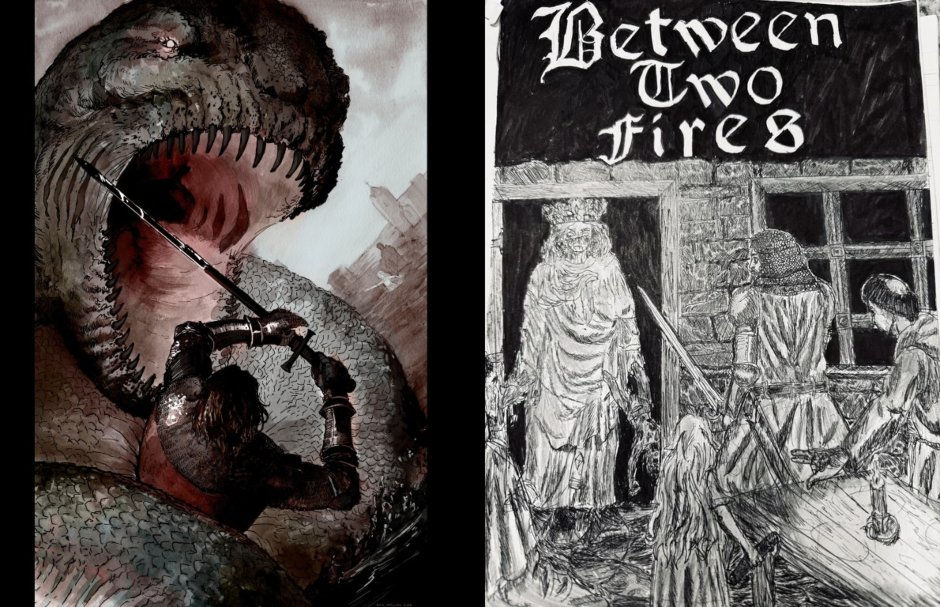
Angels & Devils
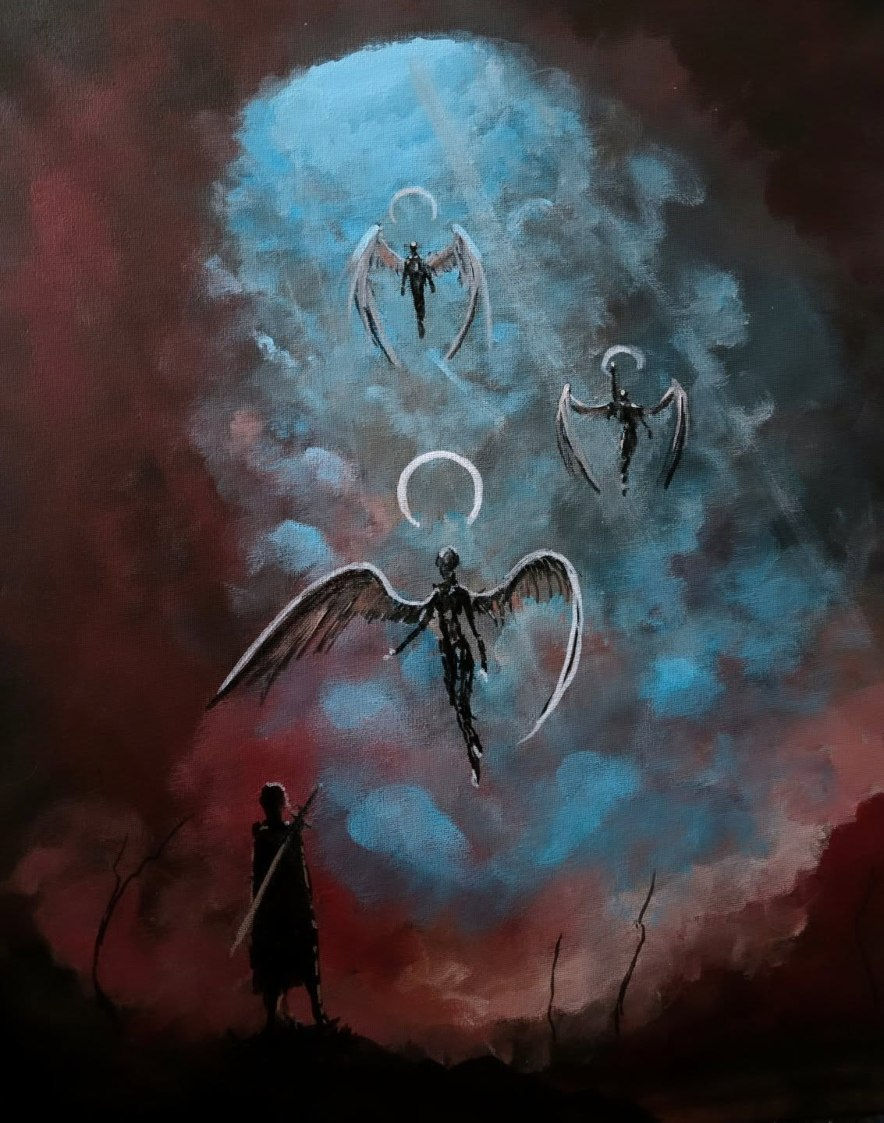
Okay, I perhaps forgot to mention that each section of the book opens with a chapter about the war between Heaven and Hell, ending with a repeated motif that God was missing and silent. That in this case the Black Death is not an indication of divine anger but divine absence, allowing devils to run rampant through the middle world where humanity dwells. That Delphine, along with a few angels, were placed with care on Earth to do as much good as possible without alerting the enemy (occupied sieging the gates of Heaven) to their presence. My bad!
I love stories that play with these ideas of Heaven and Hell, and Between Two Fires has a lot of gothic medieval fun with them. God's absence is also a plotline in Preacher, which likewise offers a chaotic and fun ride, though is otherwise almost entirely different in where it goes with these ideas.
But probably the strongest part of this book for me is the adventures themselves. Short otherworldly encounters, often with little logic to their arrival or origins, which test and torment our protagonists along their quest. These feel realistically biblical at times, else easily imagined as being lifted from The Green Knight or The Odyssey. The Night Tourney, where ghosts rise up to tempt Thomas and Matthieu, and a few of the scenes in Paris, with the taunting devil-inhabited statues, stand out in my mind right now, but many of these chapters would make wonderful short stories in their own right.

As for the book's conclusion, I'm actually a little more torn. Two of Lucifer's head devils rip Thomas and Delphine to shreds, despite their courage and possession of ancient Christian artifacts. It turns out Delphine was God borne unto Earth once more, and her sacrifice finally allows God to answer: having Archangel Michael and the Heavenly Host emerge and cleanse the world of devil-kind. During this rout, the angels apparently even get far enough to kill Lucifer—who is immediately replaced by Mammon—somehow, which is cool but doesn't necessarily resonate for me.
A blink-and-you'll-miss-it moment that absolutely did work for me was when, during the fighting, we see a devil choose redemption and re-ascend with its angelic kin. Because, analysis time: the book's about redemption! Thomas had fallen, been mocked and kicked while he was down, and managed to get back up over the course of his adventures with Delphine. Père Matthieu, after years of struggling with his inner conflict, reconciles his belief and nature and dies saving Delphine from a devil zombie-head-jellyfish ambush. Delphine was ultimately still human all along and reached her destiny through faith in what is good and right. God brings her and Thomas back to live simple, satisfying lives, and he even manages to reconnect with his wife in a small way.
Final Thoughts
This is a fascinating story, and as I said at the top, I'm very glad I read it. I loved how unique it was in many ways, but also how many powerful similarities it held to other stories and pieces of music I hold close to my heart.
One way in which it's fairly unique these days is the way it does mostly uphold a cosmic black-and-white, good-and-evil system of morality. God is Good, Lucifer is Bad. Thomas is Bad but becomes Good, as does that redeemed angel. It's interesting to return to those ideas when just about every story I can think to compare it to prefers a postmodern look at grey morality and gritty human reality.
For me personally, the ending didn't quite manage to match the build up—but that's okay, because the journey was truly excellent in its own right. And I do have to mention how wonderfully fitting the title is: Between Two Fires literally referring to how Pope Clement VI sat between two blazing fires in the belief that it would stave off infection, but also painting an image of humanity suffering and dying between the raging and warring forces of Heaven and Hell, right and wrong, good and evil.
It's a powerful book with some wonderfully creative and evocative imagery, which manages to convey a lot of real historical events while also bringing fascinating fantasy and horror to bear. Give it a read if you're of a mind to!
If you have read it, what are your thoughts? Any favourite moments or ideas I missed?
Thanks for reading and until next time <3


Comments