


Turning Conflict Into Community in Children of Time
Finding common ground before it’s too late
The Series
In the past week I finished my re-read of Children of Memory and rapidly devoured the newly released Children of Strife, so you can bet Adrian Tchaikovsky's storytelling and ideas remain front and center of my mind.
Last week I took an in-depth look at the various shapes of human consciousness in the first three novels, focusing on the posthuman journey and lives of Doctor Avrana Kern in addition to the more alien experiences of other characters. (Reading the remainder of the series this week has me already itching to write another follow-up, but I'll save it for my upcoming review/analysis!)
In addition to all the consciousness shenanigans though, this series is about groups with little in common, often on the brink of mutual destruction, finding kinship and creating community out of their shared life and intelligence. That seems like a pretty important idea for us all, so let's take a look at how it comes about in these novels!
Spoilers ahead, though I'll stick to discussing each book at a time in case you're somewhere in the middle.

Children of Time
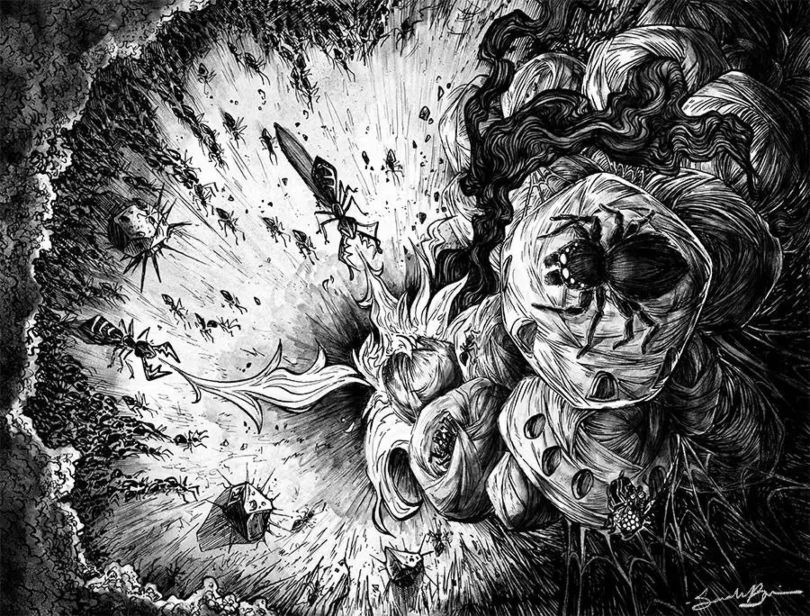
The first novel in the series establishes its central conflict from the beginning. On Kern's world, we watch portia labiata evolve from simple hunters into an intelligent, communal species under the (mis)guidance of their accidental creator Dr. Avrana Kern. We see the spiders learning to work together, dealing with external and internal conflicts, developing wholly new science and struggling with religious fanaticism and extreme gender inequality.
Aboard the Gilgamesh, we learn that human descendants have survived and escaped the ravaged, poisoned and frozen Earth, millennia after Kern's generation waged wars of annihilation against each other (watch today's music video above!). We see these new humans trying to be better than their violent and greedy forebears, and struggling desperately with it as soon as hard decisions must be made. Nonetheless, these are possibly the only living humans in the universe – and they would love to be able to start fresh on a lovely green planet prepared for them by the terraformers of the past.
There are hints throughout at how each side will ultimately respond. Faced with doom in the form of an uplifted, adaptable invading ant colony, the Portiid spiders eventually devise chemical techniques to isolate individual ants and take control of them – ultimately rendering the army harmless and granting the spiders a programmable workforce. When the Gilgamesh faces insurrection from doomed would-be-colonists and later civil war, matters are resolved by the business end of a gun.
Thus when the moment of collision occurs and the Gilgamesh will either colonize Kern's world or be destroyed, the situation is devastating. Even if you get over your empathy for the humans, they're clearly going to burn as much of Portiid civilization as possible on their way out. Yet at the peak of the book's climax, we see that the spiders aren't actually here to kill: they're injecting individuals, then the Gilgamesh's life support systems, with a modified version of the uplift virus to reduce human hostility and help them see the spiders as fellow intelligent beings.
If human nature had prevailed (including Kern's, who disagreed with the plan and wanted her human kin destroyed), another green world and billions more lives would have burned. So the Portiids repeated what had worked with the ants, and transformed their foes into members of a new community. Connection and empathy, over xenophobia and destruction.
Children of Ruin
The second book (set up by Children of Time's epilogue) then sees a small group from this community set out to explore another star system, this one both on Kern's map of terraforming projects and showing signs of activity in the form of radio signals.
While there are minor conflicts among the crew of the Portiid ship – Helena/Portia and Meshner/Fabian's rival attempts at enhanced interspecies communication, gender dynamics between Fabian and the female spiders, Kern's fascination with Meshner's implant – they are generally just the protagonists exploring a complex situation, unlike either side in the first book.
In addition to the current mission, Children of Ruin tells the story of the terraformers (co-temporaneous with Avrana Kern) who first visited the system thousands of years ago. We learn about the scientist Disra Senkovi, who oversaw the terraforming of the planet Damascus and gifted it (along with human technology) to his uplifted octopuses. We see the rest of the terraformers discovering alien life on the planet of Nod, before suddenly being infected and destroyed by the Nod parasite. Their leader, Baltiel, unfortunately makes it to Damascus before expiring – eventually leading to the parasite destroying all octopus life on the planet and stranding the cephalopods in orbit.
Thus the Portiid/Human crew spend the novel working to solve not one but two dangerous first contact scenarios. The octopuses associate humanity with the parasite, but also with their creator. Their nature as a people who constantly challenge and change their preconceptions means they are divided on whether to respond with violence or curiosity, and remain so until the issue of the parasite is resolved.
It is Kern, through Meshner's implants, who finally makes contact with the Nod parasite and is able to properly understand the situation. The parasite fervently wishes to know more of the universe, which it discovered by inhabiting and mimicking the minds of the first terraformers. Yet it has also realized that by consuming things and people, it is destroying the novelty and uniqueness of those experiences. Kern helps it reach this conclusion by extrapolating its current course: that one day it could inhabit the entire universe, and be just as wanting and desolate as it is now. Instead, they reach a solution: the parasite can travel along with the Humans and Portiids, even in the bodies of consenting individuals, and experience the wonders of the universe that way.
Both conflicts in Children of Ruin are resolved first and foremost by establishing communication and finding empathy by understanding the wants and needs of the other party. It's Helena and Portia's approach to communication which helps them begin a dialogue with the octopuses, and Meshner and Fabian's which turns the Nod parasite from an apocalyptic threat into a strange ally. Again, the community grows and violence is averted as a result.

Children of Memory
The third novel is a little different, so this section will (hopefully) be much shorter than the previous two. Children of Memory again builds off the epilogue of its predecessor, which in this case already included a pair of Corvids aboard the Portiid ship heading off to new adventures.
And indeed, first contact with the Corvids on the planet of Rourke is more background than focus of Children of Memory – the only conflict, other than the story of how they evolved intelligence without the uplift virus – being Kern and the crew (including the Corvids) debating whether the birds are truly sentient or not. (I enjoy the conclusion the Corvids draw, that no they aren't intelligent and in fact no one is.)
Instead, this theme of conflict vs. community mostly manifests in the xenophobia held by the colonists of Imir (from another ark ship like the Gilgamesh, rather than humans of Kern's time). They blame any and all wrongs on imagined outsiders, which ends up being a convenient excuse for people inside the community to commit theft and violence.
Thus Tchaikovsky demonstrates that this theme doesn't only go one way: if we're not careful, community can turn into conflict and alienation all too easily.
(Okay, there's also lots of great moments on the level of individuals where friendship and empathy overcome apathy and self-centeredness. The Corvids go above and beyond in proving their worth by finding Miranda in the simulation, and Miranda brings Liff out into the real world, despite her never having actually existed.)

Children of Strife
I'll aim to keep this short as well, and save most details for my review/analysis. That said, damn but this book has a lot of fascinating things to say! (Remember, here be spoilers!)
The central conflict is all on the planet of Marduk, where some terraforming rivals of Kern's have managed to upload themselves into the world's biosphere. (Yes, that would've been a great fit for last week's article. Oops!) They don't quite have the apparent fidelity of Kern's consciousness transfers, but they started off as egotistical, ruthless bastards in life and their tenure as gods hasn't taught them any humanity in the interim. Trapped, eking out lives on Marduk by bowing to their gods' wills are the human descendants of another ark ship.
It's into this dynamic which a Panspecific (Tchaikovsky's finally named the Portiid-Human-Cephalopod-etc. etc. society!) crew of outcasts are dropped. One of them, Mira, is a constructed persona of the Nod parasite, and she ends up representing another conflict as her buried consume-everything nature threatens to destroy all life on the planet.
But the book is also very much about Cato, an uplifted stomatopod from the seas of Kern's world. Their society is a feudal warrior culture which praises honor and capability of violence – and Cato was the epitome of that ethos, until recently, when he's been forced to re-examine his ways and consider other perspectives.
While Mira is ultimately brought back into the fold by communication and empathy (including Cato staying his violence at a pivotal moment), the gods of Marduk need a little more convincing. As with the Portiids defending themselves until they can convert the humans in the first book, Children of Strife gives a reminder that bullies might first need to be met on their own ground before they find the light. And it's in that arena, of carefully applied force in defense of the innocent, that Cato is able to shine.

Talk, and Listen
So, yeah. Communication is a two-way street, as these books demonstrate. Just because I have answers applicable to my life doesn't mean I should blindly try to apply them to yours.
I love that Tchaikovsky explores so many different versions of these scenarios, showing how neither the problem or the solution to conflict is going to always be the same.
Anyway, look forward to my review & analysis of Children of Strife soon. And this song came up while I was writing and it felt relevant, so I'll include it at the end.
Thanks for reading and until next time <3


Comments