


‘The Devils’ by Joe Abercrombie | Review & Analysis
A vampire, werewolf, pirate, necromancer, monk, princess, elf and revenant walk into Troy
Joe Abercrombie
Happy New Year! I’ve spent a good portion of my 2026 so far with Joe Abercrombie’s The Devils (2025) and, as the title might suggest, I want to talk about it.
After more than 140 articles here you’d think I’d have covered most of the series I’ve read and enjoyed, yet thus far I’ve somehow only alluded to Joe Abercrombie’s The First Law trilogy twice, with regard to tea and a character with disability. (Though it strikes me now that I certainly overlooked Logen Ninefingers when listing potential Einherjar characters.)
Joe Abercrombie is best known for The First Law and the many other books and stories he’s written in that world. I’ve only read the first trilogy so far, but adored a lot of its worldbuilding and complex characters. On the other hand, I had issues with the lack of women in the books and how they handled race.
All of which intro is to say that The Devils solves one of those problems, at least! This is Abercrombie’s first book separate from the world of The First Law in a decade, and I’ll say up top that I really enjoyed it! So consider reading it first if you want to avoid the spoilers ahead.

Alternate History & (Euro)Fantasy
Unlike The First Law, The Devils takes place in medieval Europe – kind of. Rather than building from the foundations of ancient Greece and Rome, this Europe is descended from (the Witch-Engineers of) Carthage and mythical Troy. Abercrombie illuminates some key 'historical' differences in a passage I find utterly fascinating from a worldbuilding lens:
"... set into a dome decorated with scenes from the history of Ancient Troy: Hector humbling Achilles, Cassandra tricking Odysseus, the burning of the Trojan Horse, the triumph of Astyanax and the sack of Mycenae." - The Devils, Joe Abercrombie
Thus the events of the Iliad and Odyssey are re-written with Trojan victors, with Carthage taking Rome's place as the architects of a grand empire that has since collapsed (with the city itself having apparently been sucked into hell). There are far more differences than I could list here with any brevity, many of which are varying shades of wonderful.
One that is... let's say complex, is the idea that the world east of Troy is full to the brim with hordes of man-eating elves. That Troy was the focus of this world's Crusades, because it is a beacon and bastion of defence for Europe against this alien threat. And look, from a fantasy worldbuilding perspective I absolutely love these ideas. But as a person wary of Euro-centrism and cultural erasure in media... what happened to the Levant and Asia? ('Afrique' is mentioned a few times as its own distant, mythical place and the Americas not at all.)

This is the first book of its own trilogy, so there's every chance Abercrombie will expand on this later. We also spend the novel with an elf in Sunny, who behaves very differently than the stereotypes (and Jakob's experiences) suggest, so I'm certainly willing to believe that there's more to the elves than meets the eye. But man, I woulda personally thought twice before basically dividing the world into |Europe| and |Violent Savages|.
*Upon doing a little research, it sounds like Abercrombie intentionally based the elves on European fears of threats from the East. Which; great, cool. But is literalizing those fears actually helping anything? Maybe an issue I'll return to in another article. What do you think?
Another difference in this Europe, you may have noticed, is the fact that all sorts of powerful magic exist. We have vampires, werewolves, sorcerers, magicians, demons, yada yada yada. The characters we follow (I haven't even gotten to the plot yet, have I?) are apparently bound by God's will through the (Western, female) Pope, though it's hinted toward the end that there might be a trick to that, so I wonder whether there really is any divine magic at play in this world.

Plot & Characters
It's a Suicide Squad, basically. The Western Church has dirty work that needs doing, and they have the 'Chapel of the Holy Expediency', or the Devils, to get it done. In this case, their job is to bring the long lost princess of Troy, street thief Alex, to be crowned Empress. They are newly led by Brother Diaz, a fairly hapless monk who wasn't looking for this kind of promotion.
The Devils themselves are Baptiste, a roguish jack-of-all-trades; Jakob of Thorn, a knight in search of redemption and cursed with immortality; Baron Rikard, a vampire; Balthazar Sham Ivam Draxi, a necromancer; Sunny, an elf; and Vigga Ullasdottr, a Swedish werewolf.
The book sees them facing down all manner of fun and dangerous threats on their way to Troy, mostly brought to bear by Alex's cousins who would have preferred the heir to remain lost. When they do finally reach Troy, things go surprisingly perfectly! (Until they don't.)
I have to give Abercrombie credit for keeping me on my toes with the pacing and tension – things might be just on the edge of feeling like a slog, but then the situation would wrap up cleverly and often humorously, and just like that we'd skipped ahead to the next thing. I experienced a nice mix of picking up on a few of the twists while also being bamboozled by others, so I could feel satisfied but certainly not bored. That was perhaps also aided by the strange darkly comic tone of the novel, which a few times transitioned from quaint to grotesque (or the other way around) at the blink of an eye.

The worldbuilding may have cemented by enjoyment of The Devils, but it's the cast and their interactions that make this book as good as it is. Brother Diaz is the quintessential straight man in this group of monsters, whose perpetually flabbergasted state is only made funnier by his attraction to the massive crude pagan Vigga. She's absolutely phenomenal herself, with the memory of a goldfish, occasional profound insights and all the ass-kicking prowess in the world.
Alex is the heart of the group, constantly doubting herself and (rightfully) scared to death of both her protectors and her true enemies. Watching her relationship with Sunny blossom over the course of the book was really lovely, especially when contrasted to Diaz/Vigga and the not-to-be Balthazar/Baptiste. Sunny herself is excellent, incredibly capable of changing the shape of fights by trickery, yet also utterly isolated and living with every belief humans hold about her kind.
Balthazar Sham Ivam Draxi, third-best necromancer in Europe, is a stuck-up ass who spends half the book trying to become its villain, by breaking the Papal Bond and enacting his revenge. Of course he eventually finds a heart (his own, in addition to the many many corpses he puppets), and ends up having just as much of a character arc as Diaz and Alex.
Jakob of Thorn may not change much over the course of the novel, but he's got enough history to explore that I look at him with very different eyes towards the end. The man may be immortal, but he keeps the scars, the aches, the stabbing pain of his wounds. We learn that he held high rank as a Templar and did some awful things before taking his current oaths, and it's fascinating to see his weathered faith contrast with the various philosophies of the group around him.

The last two characters are the only members of the party who don't have point-of-view chapters. I briefly alluded to Baron Rikard towards the end of last week, and while he's a very fun vampire I don't think he quite needs his own post – at least not yet. The Baron has a slightly strange place in this book, serving as a fatherly/apathetic etiquette teacher to Alex, dark confidante/heartwarming inspiration for Balthazar, and being very all-or-nothing in the group's encounters.
Rikard has the ability to charm people by talking to them, at the cost of rapidly aging. (It's hilarious that he always ends up talking about his wife's dumplings, regardless of the context.) There are a few times in the book where Rikard puts his power to use and saves the day. There's also one scene where he just shows up to bite a guy. And there are other scenes where he's just gone, with no explanation. I guess the implication is that he's feeding on enemies so sneakily that the other protagonists don't take notice... but it ends up feeling very constructed/artificial what role he plays in a given scene, basically just whether Abercrombie needs him as a deus ex machina or not.
Baptiste is fun, constantly switching between saying she should have retired after the last job and mentioning strange roles she's played in the past. She's a fun partner for Jakob, a fun banter buddy with Balthazar, and is a key actor at a few key moments in the plot. She's also the only one who dies; offscreen to an out-of-control Vigga, presumably saving Brother Diaz's life. We don't even get a hint of Balthazar being interested in trying to properly resurrect her – he simply mourns with the rest and moves on.
I dunno, I think she deserved better. Adrian Tchaikovsky has a character named Banders in The House of Open Wounds (Tyrant Philosophers Book 2) who plays a similar role and ends up working extremely well; maybe she set my expectations too high. But I also think there's gotta be some connection between Rikard and Baptiste's issues and their lack of PoVs – perhaps being rushed or afterthoughts compared to the rest of the cast.

Favourable Beginnings
As always, my nitpicks will be louder in a post like this than my praise, because I want this book (and world and series) to be the best version of itself. The Devils' epilogue already shows Diaz's (he chooses to stay in Troy with Alex) and Baptiste's replacements showing up for duty, so I think it's clear that the Chapel of the Holy Expediency will be taking on more of God's dirty work before too long.
Assuming that we do follow these characters again in the sequel, it will be fascinating to see how Abercrombie handles: Jakob post-Baptiste; Sunny post-Alex; Balthazar with his newfound heart and renewed hope of breaking free; how much of this Vigga even retains; and whether we see Rikard better-developed or otherwise play new roles. I could easily see a world where Baptiste's position is filled by a new person each book, but hopefully the new guy ends up being a little more interesting than the first glance suggests. As for their new priestess, I'm excited to see someone coming back to the job and playing a very opposite role to that of Diaz.
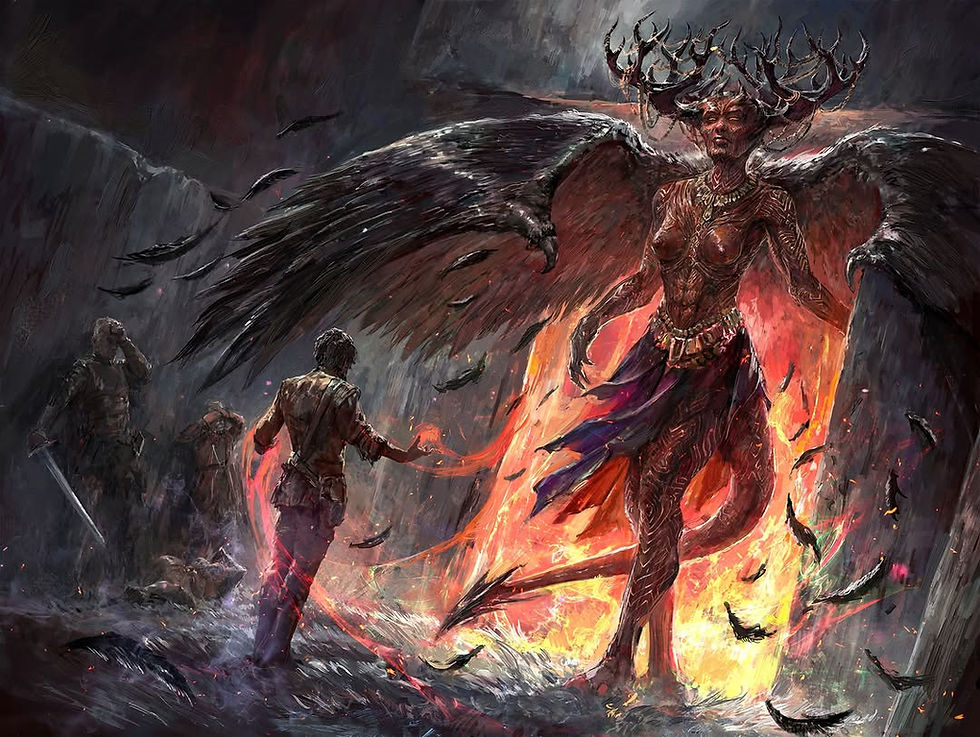
I certainly hope we get more about the elves, though The First Law isn't the most promising blueprint in that regard. Likewise more exploration of the world and cosmology in general; as you'll see below, Balthazar summoning a Duke of Hell was certainly a moment to remember.
Thinking of picking up the book? Read it already? Curious to hear your thoughts!
Thanks for reading and until next time <3


Comments