


The Will of the Many by James Islington: Review & Analysis
Another bestselling critique of late-stage capitalism
What is this book? (No Spoilers)
The Will of the Many (2023) by James Islington is marketed as epic fantasy, a classification which immediately resonates with its size—nearly eight hundred pages long—and that it is only the beginning of a three- or four-book series.
If you’ve read my post from last week on the dangers of romance-as-reward tropes in science fiction and fantasy, you’ll already have some idea that this won’t be my most glowing review. But for what it’s worth, it also won’t be my harshest: unlike with Katabasis, I certainly wasn’t left feeling like the author gave up halfway through.
My main issue with The Will of the Many, which I’ll get into further in spoiler territory below, is that it is doing very little that is new or interesting. Granted, that’s partially down to my personal exhaustion with many of these tropes—it’s not hard to see why this book would come off better to readers with less experience of the genre.
So while we’re here in the spoiler-free zone, I’ll share some similar stories and a few alternate recommendations to give you a sense of this book.
Red Rising and Empire of Silence are the most strikingly similar books I've read, but insert any narrative about a young man seeking revenge against empire here and you won't be too far off the mark. Probably more universally relatable is simply The Hunger Games, which I'll return to further on.
If you're like me and are more interested in novel and boundary-pushing stories than reading the 'next best' edition of the same old formula, I think Seth Dickinson's The Traitor Baru Cormorant and Adrian Tchaikovsky's City of Last Chances are far more interesting and engaging explorations of anti-imperialism.
On the other end of things, if you just want a more fun magic-adventure-in-fantasy-Rome, I quite enjoyed the Codex Alera series by Jim Butcher (lost Roman legion enters world with elemental Pokémon and wolfmen and Zerg).
But I guess we're here for a reason, aren't we. Let's get into spoilers ahead.

A Familiar Synopsis
Vis is our hero, born Prince Diago of the island nation of Suus before his family were killed and land taken by the Catenan Republic, forcing him to go into hiding. Despite being only seventeen, his noble education and difficult life since have shaped him to be both incredibly smart and a badass in a fight! (Paul Atreides who? Can't wait for Chalamet to be cast as Vis too.)
It's in this early section that we learn just about all there is to know about this world's magic system. After a ritual involving the Aurora Columnae (white pillars that are relics from another era), people in this world are able to cede their Will (half their life force and intellect) to those above them in a strict pyramid-shaped hierarchy. Vis has managed to avoid the Columnae and ceding, so retains his full individual Will while beating up Septimii (who wield Will equivalent to 2.5 people) and even a Sextus (9.25) in his underground fights.
Suddenly, Vis is being adopted by Magnus Quintus Ulciscor, who wants someone untouched by the Columnae to attend, infiltrate and investigate the elite Catenan Academy. They encounter the violent rebel group the Anguis along the way, one of whom is secretly Vis's new mother; Vis is trained more and harder by Lanistia; lots of politics, and hints at schemes, and baths; then finally Vis is in the Academy.
Let's be honest, the Academy is the reason this book succeeds—echoing The Name of the Wind and Fourth Wing and Transphobic ScarBoy and Ender's Game and Red Rising and on and on. I've read it before and so have you. So I hope you'll forgive my not delving into every moment of interpersonal drama or Vis's quest to rapidly rise through the ranks.
It's Vis's time sneaking out of the school that's actually interesting to me, wherein he finds more relics and ruins from bygone eras, hinting at alternate realities and gruesome means of traveling between them. It's revealed that the Academy's Labyrinth test is a recreation of a deadly trial involved in achieving Synchronism, apparently important to reaching these other worlds.
Would you believe it: the school year ends with a battle royale and oh—the drama. [Insert how much I care here.] Vis successfully runs the real Labyrinth and comes back with mysterious new abilities; the epilogue reveals that he's actually been cloned into one of (probably both) the other worlds simultaneously.

The Great and the Good
If you can't tell from my tone, I really want to dislike this book. Yet I have to admit it's a functional, decently well-structured story with a clever allegory for our world defined by late-stage capitalism.
The Catenan Republic makes ceding Will to your 'betters' an essential aspect of living in their society, just as we're obligated to participate in the economy as workers and consumers. Those who refuse in the book can be placed in 'sappers', which painfully drain Will while keeping their victims on the maddening edge of consciousness. Prison labour in our world isn't much better, forcing people into the system while denying them most of the benefits.
The people at the top, whether gathering the Will of thousands or sitting on billions of dollars, are still only human—certainly not morally elevated by their power, despite society's worship and respect for them—and only hungry for more. It's the kind of simple yet potent symbolism that we all wish we'd come up with ourselves.
(I will briefly note that I think Brandon Sanderson's Warbreaker has a much more interesting depiction of one person holding the life force of thousands in the God King Susebron, though: I haven't yet seen a Princeps in this series, and Warbreaker lacks the larger hierarchical allegory.)
And yeah, the mysteries around all the history, relics, other worlds and the Labyrinth were just plain cool. Estevan's alien abilities and the hinted connection to Suus and Vis's parents added to my fascination.
(Though, I think Mark Lawrence did many of the same things first and better in the Book of the Ancestor trilogy, where the Blade-Path—a simpler Labyrinth—was secretly a physical stand-in for the process of accessing the Quantal Path and was connected to many secrets of the world.)
The Tired and Frustrating
I think I’ve already made many of my gripes clear about the many tropes The Will of the Many is built and succeeded on. In addition, if I had any patience left for this type of protagonist after Red Rising and Empire of Silence, Vis has now utterly depleted it—as Ryland Grace did for the geeky sci-fi protagonists when I read Project Hail Mary.
(I do want to say, The Will of the Many is at least far better than Empire of Silence at masking and reimagining its many significant inspirations.)
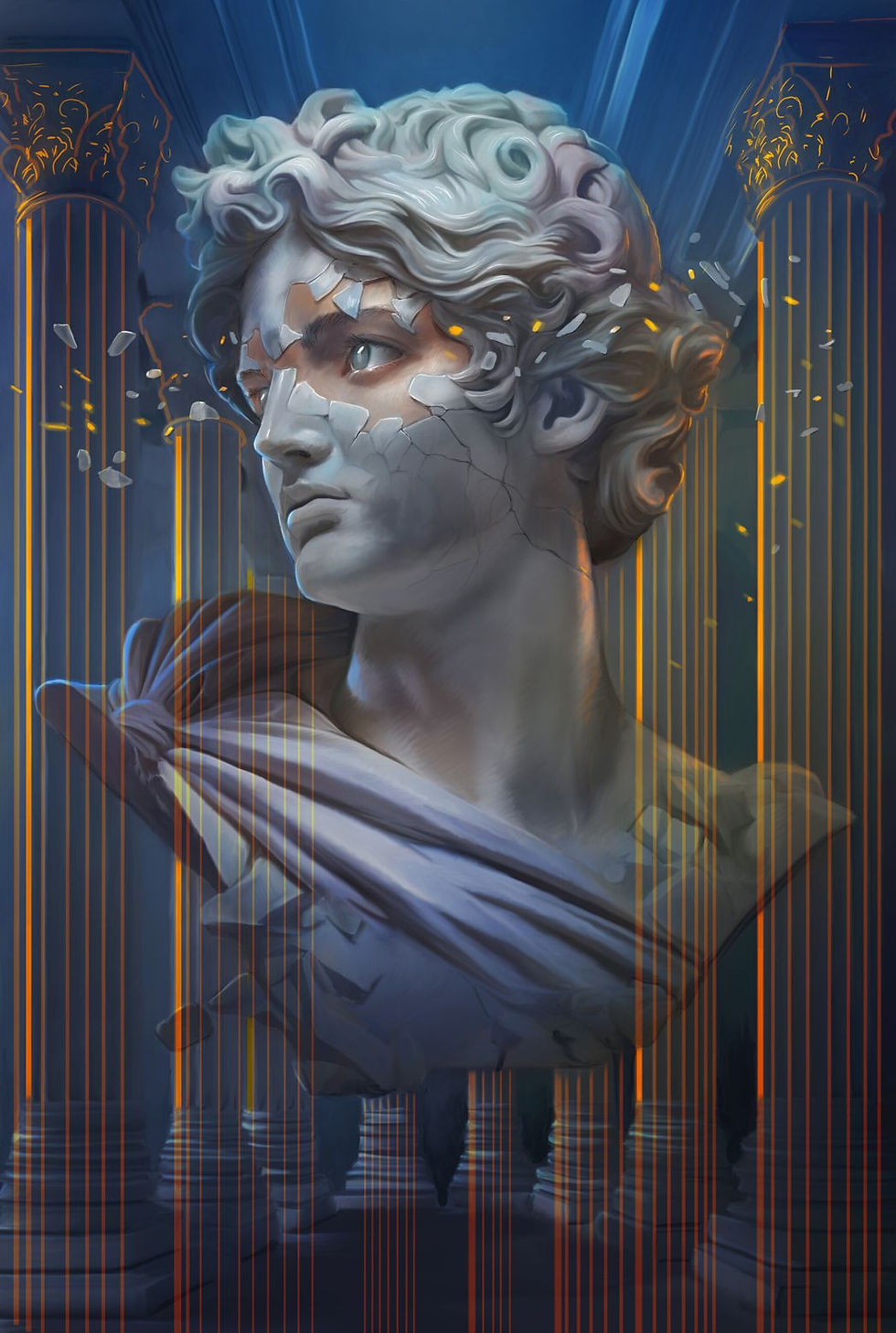
This book also doesn’t portray queerness, race, gender, disability or even economic class in any interesting ways. (Vis is subtly implied to be dark-skinned, not that [any?] official or fan artists got the memo—see him looking rather white popping out of the marble above.)
Does it portray any of those things outright badly? No, it just prefers not to engage.
But that’s the thing, right? Can you have an effective critique of capitalism and imperialism that refuses to engage with any actual aspects of oppression, let alone their intersectionalities? And frankly while having the protagonist continue to luxuriate in his noble station and all it entails?
And like with Vis as the protagonist, the issue isn’t that The Will of the Many is an offensive outlier—it’s that these soft, somewhat hypocritical ‘critiques’ have become the norm. The bestselling norm, even.
Suzanne Collins, author of The Hunger Games, has lamented the way the dire warnings of her series have repeatedly been diluted, sidestepped and misinterpreted. She even raises this quote from David Hume, particularly apt for The Will of the Many:
“Nothing appears more surprising to those, who consider human affairs with a philosophical eye, than the easiness with which the many are governed by the few; and the implicit submission, with which men resign their own sentiments and passions to those of their rulers.”
Yet repeated exposure has failed to overturn our corrupt systems—if anything, it may be serving as an inoculation against actual change. Since everyone is aware (that everyone is aware) that something is wrong, we’re all individually less likely to act. The Bystander Effect, Narcotization dysfunction, Jester’s Privilege, what have you.
(I may still write more on it, but I think today’s song ‘Spillways’ is likewise about how repentance and prayer can’t fully absolve inner torment, let alone fix the real world around us.)
And I’d argue that by being so milquetoast in its critique of the system (while simultaneously winning big in the system), The Will of the Many is strongly representative of the problem as a whole.

Copy and Paste
On the other hand, maybe this is someone’s first glimpse at seeing these ideas explored and represented in science fiction and fantasy, and maybe it resonates with them as other stories did for me. I certainly hope so!
The book does offer a touch of real philosophical debate between Vis and the Anguis: the rebels see every Catenan person as guilty for their participation in the system and therefore deserving of death, while Vis sees the lack of alternatives available to the vast majority. It’s not much, but it’s at least raising the question of personal responsibility.
The idea of Vis being copied sounds neat at first, but I’m tired enough of one of the guy. Still, learning more about the mysteries of the world will probably draw me to at least try The Strength of the Few before passing judgment.
As I think I said with Katabasis, I wouldn’t be this harsh or verbose if this wasn’t a solid, promising book in a lot of ways. If you enjoyed it, I’m glad! I also hope you’ll go on to read more of what the genre has to offer.
Read it, read one of the dozen other books I listed—you do you!
Thanks for reading and until next time <3


Comments